
Showing posts with label Donald Glover. Show all posts
Showing posts with label Donald Glover. Show all posts
Thursday, April 24, 2014
Throwback Thursday Bonus: "Bro Rape"
One of the best video shorts ever produced. I've seen it so many times, but I'm just now recognizing the amazing acting quality of some of these performances.

Wednesday, February 5, 2014
Childish Dawn
...or is that PM Gambino?
From AV Club:
From AV Club:
BBC Radio 1 has convinced all sorts of artists to cover tracks for its Live Lounge video series. Haim took on Miley Cyrus, Angel Haze did Beyoncé, and now Donald Glover has taken his turn. The former Community star known as Childish Gambino turned in a solid cover of P.M. Dawn’s 1992 hit “I’d Die Without You.”
Thursday, August 1, 2013
N Danger

By now, you've heard it. Or at least heard about it. Riley Cooper, a wide receiver for the Philadelphia Eagles, got caught on camera saying, "n****r" while at a Kenny Chesney concert. There are a few different responses that this story has brought about in me, so I'll try to elaborate upon each of them.
(1.) Comedy
There's an overly-abundant amount of humor to be found in the fact that Cooper drops this word at the one place in Philadelphia where you're not very likely to spot a black person: a Kenny Chesney concert. [I said Philly, not Pittsburgh...shut up.]
In the now infamous video, we never see exactly who Cooper's talking about, or why he's so mad. It actually feels unlikely that the people he's calling "n****rs" are even of color, simply because of the circumstances. [NOTE: If the people and/or reason have been revealed by now, I apologize for my lack of research here. I've been waiting to hear something about this; but as of writing this, no one seems to have mentioned it. I admit, though, that I've been short on free time the last couple of days, and could easily have missed something.] And if Cooper really did use the word on someone who isn't black, then maybe he's just a Donald Glover disciple?
(.2) Indifference
If, indeed, Cooper used the word on people who weren't black, I'm not sure I care. I actually agree 200% with the point Glover is making in that clip. Words are only words, and only have as much power as you appropriate to them. Do I like the n word? No, of course not; the fact that I say "n word" instead of the actual word is, in part, evidence of that. But it's also a product of 30+ years of being conditioned to hate it. There are, in actuality, no "bad words." There are only words that people have been told by other people that they're not supposed to say or hear. A word is only as powerful as the intentions of the person using it.
If, while walking down the street, I turn to an approaching stranger and say, "Fuck off," there's an intent to harm and/or offend that justifies anger on the stranger's part. But what if, instead, I drop my beer at the bar and say, "Fuck!" as a stranger walks past. What harm has been inflicted upon the stranger? Has blood started pouring from his ears? Has a demon sprang forth from the earth and started raping his parents? Of course not. It's a silly, outdated concept to have words you can't say.
So if Cooper used the word specifically because the people at whom he was angry were black, then this is a story. If he simply used it because he was angry at people, regardless of their race, then...so what? It's a word, and that's all.
(3.) Fear

Though, speaking scientifically, I'm only half black, I have always identified myself as black, without any fractional qualifiers. When you're mulatto, white people see you as "half black", and black people see you as "black*". There's an unwillingness by a white person to see you as fitting into their category. Now, the vast majority of the time, it's not a malicious attempt at ostracizing you. But its subtlety belies its power. "You're not exactly like me, so you're not equal to me."
So speaking as a black* man, I'll let all of you third parties in on our biggest fear in "post racial America": The wolf in sheep's clothing.
Look, the guys in the sheets burning crosses in the backwoods of Alabama are scary. But they are scary to me in the same way that the Taliban fighter in the mountains of Afghanistan is scary to the average person in small town America. They are extremists, living a primitive reality, and I will probably never be within their reach. And, odds are, if I ever am, I'll know that I'm putting myself in harm's way long before I'm ever actually there.
No, when it comes to terrorism, the guys who inspire the most paranoia and Hollywood storylines are the sleeper cells. The guys who live next door, that you play cards with once a month, whose kids play little league with your kids. The guys that terrify me, and who shake me to my core, are the hidden racists. The guys you work with and hang out at the bar with, who you would vouch for in a heartbeat. And, from all evidence available for review at the moment, that is Riley Cooper.

I have a lot of white friends. Some I would go to war with; an even smaller number I would die for. But, a social situation doesn't pass where there isn't a little man with a rifle standing guard in my temple, sights trained on the line, waiting for someone—anyone—to cross it. It's something I live with, that I can't imagine not living with. Every room I walk into, every smiling stranger I shake hands with, I brace myself against the unknown threat that could be lying beneath the surface. The knife you don't see cuts deeper than the one you do. And those who would be your enemies understand this better than those who only wish to be your friend.
If Riley Cooper truly harbors racist attitudes, leanings, and thoughts; if he's full of bigoted feelings that he's kept closeted until now, for the sake of his professional advancement; then let the legacy of his story be the education of those who don't live with the fear that I carry with me, everywhere I go. The fear that every black person—standing in plain sight—carries with them, everywhere they go.
Tuesday, July 23, 2013
Download: Childish Gambino -- "Centipede"

Childish Gambino is back. This track will move the room, though Glover still has a love affair with drastically switching beats midstream. That's always been a gimmicky beat-making move in my eyes, and it will never work when you start with as a strong, driving beat like this track runs over for 3/4 of the time.
Crazy use of the audio from the viral Charles Hamilton video at the end. If nothing else, Gambino is one of the most internet/tech age-in-tune artists out there these days.
Saturday, June 8, 2013
Trailer: The To Do List
"You got a dick under that poncho?"
Between that line, Donald Glover's hair, and Aubrey Plaza's wifeyness,...
TJ with the assist.
Between that line, Donald Glover's hair, and Aubrey Plaza's wifeyness,...
TJ with the assist.
Tuesday, February 19, 2013
Monday, August 6, 2012
If I Ruled the World
At the risk of Hollywood producers trolling this piece for ideas, let’s engage in a little exercise.
 The HBO series Girls, which follows the lives of four twentysomething women living in New York City, attracted a flashflood of criticism during its first several weeks for not having a racially-diverse cast. By the time the Season 1 finale aired, however, the storm had died down and the blogosphere’s self-made civil rights “activists” had found other atrocities on which to shine their beacons of truth. For the record: While I agree that, in real life, both the location and the age range of the characters in Girls would make it nearly impossible for their entire circle of friends to be white, I also recognize that the show isn’t supposed to perfectly mirror reality. Star and creator Lena Dunham has carefully constructed a world-within-the-Williamsburg-world in which the quartet of young urbanites lives. The narrowness of the ethnic spectrum in this inner-world reflects the narrowness of the characters’ understanding of the real world, and speaks ever-so-loudly to their tendency to shroud themselves in the safe and familiar. Internet critics
 are were outraged that the cast is whitewashed, but it’s merely a tool of emphasis meant to illustrate the central point; Dunham just as easily could have made all of the characters Hispanic, or entirely Black (aside from the fact that Dunham herself is white, which would have prompted a much more relevant set of criticisms). Lena’s characters aren’t racist (and neither is Girls); they are merely so afraid of growing up that they hide away in xenophobic isolation and self-centered delusion.
My exercise, though, is to meet head-on those who have condemned Dunham’s masterpiece of fiction as instead being her Mein Kampf. If you were to hand these voices in the crowd a bottle of Wite-Out [How ironic?] and a pen, which characters would they rewrite as Black? Or Hispanic? Or Asian? Or etc.? Furthermore, how would some popular TV shows and movies from the past be cast if remade today, in an entertainment world reluctantly bending to the cultural rainbow of the audience that it petitions to fill seats?
The Breakfast Club
 In the interest of full disclosure, it was actually John Hughes’ film classic—not Girls—that inspired this piece. Hollywood’s creativity whirlpool is continuously sucking in whatever is nearest its reach. I may only be as far away from a remake of one of my all-time favorite movies as a studio exec’s awaking-from-an-OxyContin-binge-in-front-of-a-TV-tuned-to-TBS epiphany. That thought isn’t just sad, it makes me crave Zoloft.
First, we can rule out “Principal Vernon” being played by a minority actor, since he’s the film’s villain. No studio would dare touch that racial-implication powder keg with a remote-controlled bomb squad robot. There is irony here, though, since the studios would instead play into a stereotype by making the evil, out-of-touch authority figure a white guy. If Hollywood has taught us anything over the last 15 years, it’s that stereotypes are only offensive when they are projected onto people who aren’t white. [“Less-than”, “forward slash”, “sarcasm”, “greater-than”…]
The movie’s only other adult character, “Carl” (the janitor), would likely be cast as Latino. Is it a stereotype? Of course. Would they still do it? Yup. It’s not the most stereotypical move they could make with the role; that would be to have the part of an older, wiser custodian played by a Black man. And casting Morgan Freeman. No, I see the producers playing the odds and hoping that casting a Latino actor would appease the Hispanic community. And, not for nothing…I keep picturing Carlos Mencia playing the part. He even has the same name. In Hollywood, convenience is nine-tenths of the law.
 They would most certainly, however, cast the role of “Andy” with an African-American actor. That may sound as risky as making the janitor Black. But “Black athlete” is the “Rick Ross’ career” of pigeonholed archetypes: It just won’t die. And, you have to admit, it could very likely make Andy’s status as one of the school’s biggest jocks much more believable than before. Admittedly, though, that’s not because he’s white in the original; it’s because he’s Emilio Estevez. The biggest piece of unintentional comedy in the film happens when Andy stares up at John Bender, threatens matter-of-factly to knock him out…and Bender backs down. If that confrontation happens in real life, Andy’s resuscitated in a speeding ambulance and Bender’s in cuffs. And when it happens in the new version, and Bender restrains himself? You evoke the themes of “white guilt” and “violent Black man” that play as familiar to today’s big-budget studio film as a drumbeat in a Top-40 DJ’s ear.
In the new Breakfast Club [“Lose the ‘The’. It’s cleaner.”], Andy Clark is the star running back on Shermer High School’s football team—no one cares about wrestling in 2012. And his “in crowd” counterpart, Claire Standish? She’s now Asian-American (this may require some tweaking of her name…), and the only other one of the five main characters to change ethnicities. This is mostly due to process of elimination: Brian brings a gun to school (I know it’s a flare gun, but…), Bender is a weedhead, and Allison snorts a line off a table (I know it’s sugar, but…). So, in a moment of tokenism, prom queen “Claire” is now an Asian-American teenager. Remember, this is a realistic world, not a perfect one; some typecasting will remain (like a Hispanic janitor or a Black star athlete who is physically-aggressive), and Claire’s parents being rich, demanding, and spoiling just seems harmonious with Hollywood’s typical portrayal of Asian-Americans (either that, or they’re ninjas). This creates an interesting scenario, though; of the five students, the two popular kids are minorities, while the three social “outcasts” are white. Does this offer commentary on the progression of racial equality in our present-day society? Or have I just created something nearly as incongruent with America’s 2012 demographics as Hughes’ 1985 movie?
Charles in Charge
One change, and one change only: “Charles” is now Black. Could. Not. Resist.
 Everyone else remains white, even Buddy—you need that narrative aid of a white friend helping Charles relate to his white
 owners bosses. This change could take his duels with the old-school Mr. Powell into “Archie Bunker vs. George Jefferson” territory [R.I.P. Sherman Hemsley]. And the sexual tension between Charles and Mama Powell? Or between Charles and Jamie (originally Nicole Eggert’s role)? Through the roof.
*pauses*
Actually, I seem to have devolved into a racially-fueled porn fantasy here. Let’s just move on…
Cheers
The first call here is as easy as it is familiar: NORM! Frankly, I’m a little shocked he wasn’t Black in the original series. Quick with a one-liner, complains about his nagging wife, hangs with his buddies in a bar too much, trouble holding down a job, curly fro…need I go on? All of these are 80’s-Black-guy-on-TV staples. I can’t decide if it’s more racist that they didn’t cast this role as Black, or that they did everything but cast this role as Black.
 As much as I cherish Rhea Perlman’s portrayal of "Carla Tortelli" in the original, I don’t think there’s any way this show gets remade without her character becoming either Black or Hispanic, and I believe Hispanic wins out. Boston has a fairly large Hispanic population that doesn’t get a lot of notice from TV and movies; and a diminutive, wisecracking, short-tempered, curly-haired waitress with eight kids? Admit it: She was a Latina in your mind before I even finished that sentence. …Racist.
And then you have Rebecca Howe. She has just enough style, ambition, and quick wit that casting her as a Black woman is all-too-easy (and it begins to make you wonder just what was up with Glen and Les Charles). There’s some precedence here, too: Anyone who watched the latter years of That 70’s Show, when Hyde’s half-sister “Angie” was introduced, will likely agree that she was a retread of Kirstie Alley’s most famous character. In fact, is Megalyn Echikunwoke available? This script is writing itself right now.
Old School
I had completely overlooked this film while searching for movies to examine; thankfully, my buddy TK was Johnny-on-the-spot. With the exception of a couple of the fraternity pledges (and cameos by Snoop and Don Magic Juan), this flick is pretty white and pasty—despite being relatively new (2003). To some extent that’s by design; but a couple of changes can still be made without losing the chemistry.
 There’s a temptation to make “Mitch” (the Godfather) Black; after all, he’s the leader (…I admit to my biases). Or “Frank” (the Tank), for that matter. But the film works because it takes the shlubbiness (let’s pretend that’s a word) of middleclass, middle-management, and throws it back into the wilds of the college experience. And—I feel racist saying it—no Black character is going to exude shlubbiness (shut up) better than a white character (sorry). *tugs at collar* Heh…
The smoother, fast-talking “Beanie”, however, is now Black. I know that may upset fans, since Vince Vaughn’s performance is Hall-of-Fame-worthy, but…“Earmuffs!”…you can’t make all the people happy all the time. Therefore, Beanie and his family are Black in the remake. And honestly, it’s a testament to Vaughn that this idea wasn’t carried out for the original. Can you sincerely say that you can’t imagine Eddie Murphy (back in his late 30s) killing it in the wedding scene? Or Romany Malco, for that matter?
“Dean Pritchard” will now be Black as well. I know, I know…I said the “minority as a villain” thing didn’t fly for The Breakfast Club; but this is different. This villain draws his spite from a lifetime of being the outcast nerd, and is now suddenly in a position of power over the cool kids who once taunted him. It has a different flavor from Vernon, a bully who used condescension in the pursuit of discipline. Pritchard isn’t about discipline, he’s all about revenge. As such, making this role a minority won’t make studio heads nervous. The perfect fit for this role? Martin Lawrence. …Well, if this was made five years prior to the original—Marty-Mar is getting up there in years. But you feel where I’m going with this. Maybe this will be something for Donald Glover to bite into in 2023.
Friends
 Back to the whole “full disclosure” thing: I’m a huge Friends fan—I can’t help it. It’s New York; it’s the twentysomething struggle (as with Girls); it’s great writing, great characters, and great acting. Love it. But, although Lauren Tom appeared in seven episodes and Aisha Tyler nine during the series’ nine-year run, overall the character list looks like slices in a loaf of Wonderbread. Like Girls, this earned Friends some bad press during its early days. Unlike Girls, though, I can’t excuse the monochromatic casting of Friends on the bases of theme and design. One or two of these characters could have easily been of another ethnic makeup.
The first change to make would be the role of “Chandler”. My initial thought was to cast him as Black, but that felt too easy. And let’s be honest: Effeminate, successful, young Black professional married to an uptight white woman? Why hello, Brad from Happy Endings. Instead, let’s cast him as Indian-American. “Paging Aziz Ansari…”
Next, let’s recast “Phoebe” with an Asian-American actress. …Her being a massage therapist and into mysticism may be influencing me slightly on this one. And it might present a small hurdle; you definitely have to be weary of this when writing for the character. It is possible, though, to write yourself out of harm’s way—most likely by beating critics to the punch with jokes that attack the stereotypes. Then again, why bother? When was the last time you saw a producer who was the least bit concerned with the stereotypical portrayal of Asian-American people?
Lastly, let’s make “Rachel” a Black woman. She remains a spoiled Long Island princess, but in 2012 there’s no reason that description can’t be filled by an African-American actress. In fact, this change brings to mind memories Karyn Parsons’ work as Hillary Banks on The Fresh Prince of Bel Air. The other roles we can leave as written by David Crane and Marta Kauffman. Monica and Ross being Jewish was the only real range of ethnicity found in the original series, and there’s no sense in erasing it now. Joey being Italian was a key piece to the character; not to mention, “dumb Italian guy” sends fewer chills up the spine than “dumb (insert minority group) guy”. So the gang is now 50% more diverse. That’s a rate well above today’s average in Hollywood, and unquestionably higher than that of…
Girls
 Changing these characters is a little tougher, since Dunham obviously molded them specifically to be white in unison. And when examining this show, the rules change a bit. Because it’s new, we’re not traveling into the distant future to create a remake; we’re traveling into the recent past to completely change the original. It’s not a reboot, it’s a reconstruction. This means, though some characters will be rewritten, it will happen within the context of the same exact show currently available on OnDemand.
Among the core four, the only change that can really be made is Marnie. Dunham (“Hannah”), after all, is the star and creator. Replace her, and you don’t have a show. Shoshanna’s sheltered, prototypical “Jewish-American Princess” background is essential to the character herself (which is played with such full-throttle abandon by Zosia Mamet that you wouldn’t dare trust the role in the hands of anyone else, regardless of race). Jessa, drowning in the modern delusions of bohemian romanticism, is too forcedly “hip” to be anything other than a white girl that’s trying too hard—and she’s also Shoshanna’s cousin. That leaves Marnie, whose uptight, play-it-safe-every-step-of-the-way personality is independent of any ethnically-dictated context.
“Marnie” will now be cast as a Black woman, but of course keeps both her fragile, upper-middleclass upbringing and the woefully-careful lifestyle that it has produced. Her soft-as-baby-shoes boyfriend, “Charlie”, will remain white, for a few reasons: (1.) Her background and given circle of friends suggests that Marnie is simply more familiar with—and comfortable around—white men. (2.) There’s irony in her “safer” option being an interracial relationship, and Dunham would likely find it to be irresistibly delicious. (3.) It’s a smaller factor, but in Episode 2 Charlie shaves his head; as a plot point, it serves to shock and throw a moment of unscheduled change into Marnie’s world. The simple fact is, however, that having a shaved head as a Black man isn’t quite as aesthetically remarkable as it is for a white man. If Charlie is Black, shaving his head without first consulting Marnie will certainly upset her; but the audience, who has only just met Charlie one week before that, won’t feel the disruption to his girlfriend’s world quite the same as they do when he’s white. (4.) Remember, Marnie’s not the only one hanging out with Charlie; he will also be friends with the other three girls—especially Hannah, her roommate. And the more people of a different cultural background that the girls have in their inner-world, the less stable that inner-world is for them.
 That being said, let’s make one more change: “Ray”, Charlie’s best friend, can now be cast as an Indian-American man. This change is a reluctant one for me. Ray’s post-hipster-apocalypse sarcastic scoff is fantastic, and difficult to replicate in a character who isn’t saddled with both the remorse of being white and a distinct apathy towards being apologetic for being white. Ray is, unflinchingly, “Ray”; and this, in turn, is actually something that allows us to change his ethnic make-up without disrupting the blissful ignorance of the group. Ray is such an individual that he transcends race. The girls will always see him as being different, no matter what his ethnicity is; they already see him as different in Girls, despite sharing his skin color. If the visual connection changes, it’s still the peculiarities of his character and conviction that will draw their attention, not his race. This also serves as further endorsement of the decision to keep Christopher Abbot as “Charlie”. Continuing the list from earlier: (5.) Charlie having a Black girlfriend and an Indian-American best friend suggests that he’s slightly more in-tune with the rest of the world than Marnie, which (I’m once again assuming) Dunham would find to be a suitable addition to the character’s traits.
Two out of seven. Of the seven most prominent characters in Girls (“Adam”, Hannah’s boyfriend, wasn’t discussed, in part because he would not have been changed), only two were altered as a result of this exercise. With the exception of the failed Charles in Charge example (finding recent pictures of Josie Davis, who played “Sarah”, didn’t help things), this increase in diversity is the smallest of the titles examined. And yet, Girls has arguably faced the most scrutiny. Is this due to its naysayers having far more outlets for social commentary than those of Cheers or The Breakfast Club? Most likely. But instead of validating these detractors, this disparity proves their folly.
 Viewers in 1985 who felt The Breakfast Club was a misrepresentation of the American population may have had some merit to their argument. Chances are, John Hughes never received the faintest breath of discord from studio people when he presented them with a seven-person cast that was white, through and through. When she first began casting Girls in 2011, though, you can guarantee Lena Dunham faced off with a nervous suit or two who felt that an all-white cast was an invitation to criticism and protest. HBO’s executives are well aware of the impact of social media in today’s world, and surely foresaw (to some extent) the backlash that would result. And yet, because there was artistic merit to her vision, Dunham’s version—and not mine—arrived on our TV screens in April.
Hollywood suits being more pragmatic about racially-sensitive artistic choices than the viewers at home? That sounds even more far-fetched than seven friends in Williamsburg all being white.
 The HBO series Girls, which follows the lives of four twentysomething women living in New York City, attracted a flashflood of criticism during its first several weeks for not having a racially-diverse cast. By the time the Season 1 finale aired, however, the storm had died down and the blogosphere’s self-made civil rights “activists” had found other atrocities on which to shine their beacons of truth. For the record: While I agree that, in real life, both the location and the age range of the characters in Girls would make it nearly impossible for their entire circle of friends to be white, I also recognize that the show isn’t supposed to perfectly mirror reality. Star and creator Lena Dunham has carefully constructed a world-within-the-Williamsburg-world in which the quartet of young urbanites lives. The narrowness of the ethnic spectrum in this inner-world reflects the narrowness of the characters’ understanding of the real world, and speaks ever-so-loudly to their tendency to shroud themselves in the safe and familiar. Internet critics
 My exercise, though, is to meet head-on those who have condemned Dunham’s masterpiece of fiction as instead being her Mein Kampf. If you were to hand these voices in the crowd a bottle of Wite-Out [How ironic?] and a pen, which characters would they rewrite as Black? Or Hispanic? Or Asian? Or etc.? Furthermore, how would some popular TV shows and movies from the past be cast if remade today, in an entertainment world reluctantly bending to the cultural rainbow of the audience that it petitions to fill seats?
The Breakfast Club

First, we can rule out “Principal Vernon” being played by a minority actor, since he’s the film’s villain. No studio would dare touch that racial-implication powder keg with a remote-controlled bomb squad robot. There is irony here, though, since the studios would instead play into a stereotype by making the evil, out-of-touch authority figure a white guy. If Hollywood has taught us anything over the last 15 years, it’s that stereotypes are only offensive when they are projected onto people who aren’t white. [“Less-than”, “forward slash”, “sarcasm”, “greater-than”…]
The movie’s only other adult character, “Carl” (the janitor), would likely be cast as Latino. Is it a stereotype? Of course. Would they still do it? Yup. It’s not the most stereotypical move they could make with the role; that would be to have the part of an older, wiser custodian played by a Black man. And casting Morgan Freeman. No, I see the producers playing the odds and hoping that casting a Latino actor would appease the Hispanic community. And, not for nothing…I keep picturing Carlos Mencia playing the part. He even has the same name. In Hollywood, convenience is nine-tenths of the law.

In the new Breakfast Club [“Lose the ‘The’. It’s cleaner.”], Andy Clark is the star running back on Shermer High School’s football team—no one cares about wrestling in 2012. And his “in crowd” counterpart, Claire Standish? She’s now Asian-American (this may require some tweaking of her name…), and the only other one of the five main characters to change ethnicities. This is mostly due to process of elimination: Brian brings a gun to school (I know it’s a flare gun, but…), Bender is a weedhead, and Allison snorts a line off a table (I know it’s sugar, but…). So, in a moment of tokenism, prom queen “Claire” is now an Asian-American teenager. Remember, this is a realistic world, not a perfect one; some typecasting will remain (like a Hispanic janitor or a Black star athlete who is physically-aggressive), and Claire’s parents being rich, demanding, and spoiling just seems harmonious with Hollywood’s typical portrayal of Asian-Americans (either that, or they’re ninjas). This creates an interesting scenario, though; of the five students, the two popular kids are minorities, while the three social “outcasts” are white. Does this offer commentary on the progression of racial equality in our present-day society? Or have I just created something nearly as incongruent with America’s 2012 demographics as Hughes’ 1985 movie?
Charles in Charge
One change, and one change only: “Charles” is now Black. Could. Not. Resist.

*pauses*
Actually, I seem to have devolved into a racially-fueled porn fantasy here. Let’s just move on…
Cheers
The first call here is as easy as it is familiar: NORM! Frankly, I’m a little shocked he wasn’t Black in the original series. Quick with a one-liner, complains about his nagging wife, hangs with his buddies in a bar too much, trouble holding down a job, curly fro…need I go on? All of these are 80’s-Black-guy-on-TV staples. I can’t decide if it’s more racist that they didn’t cast this role as Black, or that they did everything but cast this role as Black.

And then you have Rebecca Howe. She has just enough style, ambition, and quick wit that casting her as a Black woman is all-too-easy (and it begins to make you wonder just what was up with Glen and Les Charles). There’s some precedence here, too: Anyone who watched the latter years of That 70’s Show, when Hyde’s half-sister “Angie” was introduced, will likely agree that she was a retread of Kirstie Alley’s most famous character. In fact, is Megalyn Echikunwoke available? This script is writing itself right now.
Old School
I had completely overlooked this film while searching for movies to examine; thankfully, my buddy TK was Johnny-on-the-spot. With the exception of a couple of the fraternity pledges (and cameos by Snoop and Don Magic Juan), this flick is pretty white and pasty—despite being relatively new (2003). To some extent that’s by design; but a couple of changes can still be made without losing the chemistry.

The smoother, fast-talking “Beanie”, however, is now Black. I know that may upset fans, since Vince Vaughn’s performance is Hall-of-Fame-worthy, but…“Earmuffs!”…you can’t make all the people happy all the time. Therefore, Beanie and his family are Black in the remake. And honestly, it’s a testament to Vaughn that this idea wasn’t carried out for the original. Can you sincerely say that you can’t imagine Eddie Murphy (back in his late 30s) killing it in the wedding scene? Or Romany Malco, for that matter?
“Dean Pritchard” will now be Black as well. I know, I know…I said the “minority as a villain” thing didn’t fly for The Breakfast Club; but this is different. This villain draws his spite from a lifetime of being the outcast nerd, and is now suddenly in a position of power over the cool kids who once taunted him. It has a different flavor from Vernon, a bully who used condescension in the pursuit of discipline. Pritchard isn’t about discipline, he’s all about revenge. As such, making this role a minority won’t make studio heads nervous. The perfect fit for this role? Martin Lawrence. …Well, if this was made five years prior to the original—Marty-Mar is getting up there in years. But you feel where I’m going with this. Maybe this will be something for Donald Glover to bite into in 2023.
Friends

The first change to make would be the role of “Chandler”. My initial thought was to cast him as Black, but that felt too easy. And let’s be honest: Effeminate, successful, young Black professional married to an uptight white woman? Why hello, Brad from Happy Endings. Instead, let’s cast him as Indian-American. “Paging Aziz Ansari…”
Next, let’s recast “Phoebe” with an Asian-American actress. …Her being a massage therapist and into mysticism may be influencing me slightly on this one. And it might present a small hurdle; you definitely have to be weary of this when writing for the character. It is possible, though, to write yourself out of harm’s way—most likely by beating critics to the punch with jokes that attack the stereotypes. Then again, why bother? When was the last time you saw a producer who was the least bit concerned with the stereotypical portrayal of Asian-American people?
Lastly, let’s make “Rachel” a Black woman. She remains a spoiled Long Island princess, but in 2012 there’s no reason that description can’t be filled by an African-American actress. In fact, this change brings to mind memories Karyn Parsons’ work as Hillary Banks on The Fresh Prince of Bel Air. The other roles we can leave as written by David Crane and Marta Kauffman. Monica and Ross being Jewish was the only real range of ethnicity found in the original series, and there’s no sense in erasing it now. Joey being Italian was a key piece to the character; not to mention, “dumb Italian guy” sends fewer chills up the spine than “dumb (insert minority group) guy”. So the gang is now 50% more diverse. That’s a rate well above today’s average in Hollywood, and unquestionably higher than that of…
Girls

Among the core four, the only change that can really be made is Marnie. Dunham (“Hannah”), after all, is the star and creator. Replace her, and you don’t have a show. Shoshanna’s sheltered, prototypical “Jewish-American Princess” background is essential to the character herself (which is played with such full-throttle abandon by Zosia Mamet that you wouldn’t dare trust the role in the hands of anyone else, regardless of race). Jessa, drowning in the modern delusions of bohemian romanticism, is too forcedly “hip” to be anything other than a white girl that’s trying too hard—and she’s also Shoshanna’s cousin. That leaves Marnie, whose uptight, play-it-safe-every-step-of-the-way personality is independent of any ethnically-dictated context.
“Marnie” will now be cast as a Black woman, but of course keeps both her fragile, upper-middleclass upbringing and the woefully-careful lifestyle that it has produced. Her soft-as-baby-shoes boyfriend, “Charlie”, will remain white, for a few reasons: (1.) Her background and given circle of friends suggests that Marnie is simply more familiar with—and comfortable around—white men. (2.) There’s irony in her “safer” option being an interracial relationship, and Dunham would likely find it to be irresistibly delicious. (3.) It’s a smaller factor, but in Episode 2 Charlie shaves his head; as a plot point, it serves to shock and throw a moment of unscheduled change into Marnie’s world. The simple fact is, however, that having a shaved head as a Black man isn’t quite as aesthetically remarkable as it is for a white man. If Charlie is Black, shaving his head without first consulting Marnie will certainly upset her; but the audience, who has only just met Charlie one week before that, won’t feel the disruption to his girlfriend’s world quite the same as they do when he’s white. (4.) Remember, Marnie’s not the only one hanging out with Charlie; he will also be friends with the other three girls—especially Hannah, her roommate. And the more people of a different cultural background that the girls have in their inner-world, the less stable that inner-world is for them.

Two out of seven. Of the seven most prominent characters in Girls (“Adam”, Hannah’s boyfriend, wasn’t discussed, in part because he would not have been changed), only two were altered as a result of this exercise. With the exception of the failed Charles in Charge example (finding recent pictures of Josie Davis, who played “Sarah”, didn’t help things), this increase in diversity is the smallest of the titles examined. And yet, Girls has arguably faced the most scrutiny. Is this due to its naysayers having far more outlets for social commentary than those of Cheers or The Breakfast Club? Most likely. But instead of validating these detractors, this disparity proves their folly.

Hollywood suits being more pragmatic about racially-sensitive artistic choices than the viewers at home? That sounds even more far-fetched than seven friends in Williamsburg all being white.
Tuesday, July 24, 2012
Video: Childish Gambino -- "Fire Fly"
The latest release from Gambino's Camp. I've never been a fan of videos diverging from the songs they're featuring, but at least he's always cinematic with his.
Monday, July 9, 2012
Thursday, July 5, 2012

Tuesday, June 26, 2012

Thursday, March 15, 2012
Community Service
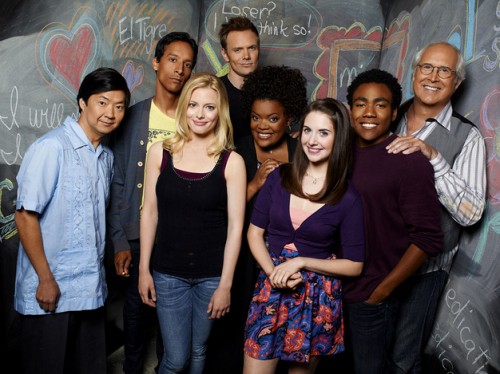
Welcome back, Community.
The beautiful, hilarious creation of executive producer Dan Harmon returns tonight (NBC, 8 pm EST) after a three month hiatus. And while nothing is certain yet, there are encouraging signs (including the completion of a syndication deal with Comedy Central) that these next twelve episodes won't be the last hurrah for Jeff (Joel McHale), Britta (Gillian Jacobs), Troy (Donald Glover), Shirley (Yvette Nicole Brown), Annie (Alison Brie...delish), Abed (Danny Pudi), Pierce (Chevy Chase), and Chang (Ken Jeong). The agent working against Community, of course, is the series' often-underwhelming performance in the ratings. America's minds—much like our guts—have always preferred fat, easily-within-reach comfort food when it comes to sitcoms. Shows that dare to make you train your eyes and ears by forgoing base, unsophisticated jokes appeal to a more savvy, well-toned-mental-physique. And, sadly, they simply don't hold as many people in front of a television for 30 minutes. Harmon packs more comedy and thought into the background of a scene than most sitcom producers put into the full half hour. The show, quite simply, is the Jay-Z to other TV shows' Soulja Boys.
Yet Community, with its dazzling dialogue and repartee between characters, and its fondness for parodying cinematic genres by expertly hitting each note of each cliched trope, has amassed a strong legion of fans around the world. If you want proof of that, just search on Twitter for "#SixSeasonsAndAMovie", the war cry of my fellow Community supporters. With a little luck, the Greendale gang will add numbers to this legion—as well as gain a significant boost in the ratings—tonight and in the weeks to come. It would be well-deserved. Shows that pack as much solid and creative talent in all three of the major areas (writing, production, and acting) only come around once in a lifetime. Letting this one die would be a Chang.
Monday, February 13, 2012
Video: Childish Gambino -- "Heartbeat"
Here's something to power you through the start to your workweek: The latest single from Gambino's Camp. Once again, Donald Glover's artistic mind draws out a more abstract, cinematic view of the theme behind the song, and not so much on the song itself.
As for the song, though, I can say this: When I first heard it, it didn't really win me over. It seemed like just a cool little track about a girl, nothing that I would've put in the top half when ranking the tracks on Camp. But one night, on about the 10th or 11th rotation of the CD over my car's stereo, I suddenly caught on to the composition of the beat, and the complexity he achieved by weaving it in so tightly with both the momentum of his flow and the context of his lyrics in each verse. Now I think it may be his most polished track on the album.
As for the song, though, I can say this: When I first heard it, it didn't really win me over. It seemed like just a cool little track about a girl, nothing that I would've put in the top half when ranking the tracks on Camp. But one night, on about the 10th or 11th rotation of the CD over my car's stereo, I suddenly caught on to the composition of the beat, and the complexity he achieved by weaving it in so tightly with both the momentum of his flow and the context of his lyrics in each verse. Now I think it may be his most polished track on the album.
Friday, January 13, 2012
Stand and Deliver: Donald Glover
[Let's see how long I can keep these "Stand and Deliver" posts going this time...they sort of petered out a couple of years ago.]
Ever notice how there's only a one-letter difference between "KIDS" and "AIDS"? Donald Glover has. From his Comedy Central special, "Weirdo".
Ever notice how there's only a one-letter difference between "KIDS" and "AIDS"? Donald Glover has. From his Comedy Central special, "Weirdo".
| Donald Glover: Weirdo | ||||
| Donald Glover - Kids Positive | ||||
| ||||
Tuesday, December 20, 2011
A Conversation with Mr. Glover
That would be Donald Glover, a.k.a. Childish Gambino. The talented comedian/actor/writer/emcee talks with Forbes.com about his success and why he hopes he never "makes it".
Friday, December 9, 2011
Christmas Spy
If you're not watching the best show on TV, you've got nothing for me. From last night's Christmas ep of Community.
Monday, October 31, 2011
Video: Childish Gambino -- "Bonfire"
Here's the new video for the first single off of Gambino's new album, "Camp". Perfect for Halloween.
Get More: Childish Gambino, Music, More Music Videos
Monday, September 19, 2011
New Music: Childish Gambino -- "Bonfire"

Sick new track from his upcoming album, "Camp".
"The shit I'm doin this year? Insanity/
Made the beat then murdered it--Casey Anthony"
Bonfire by Childish Gambino
Tuesday, April 26, 2011
Gambino is a Mastermind

This is a quick and very insightful interview with an intelligent and talented young black man who wants nothing more than for "black" to be the least-defining of those traits. Definitely worth the read.L+T: Much of your music deals with people’s stereotypes, their assumptions and the labels they put on others. It’s like you’re trying to say that the average young black person is a lot more complicated, and complex than a lot of people would give him or her credit for. Right?DG: That’s exactly what it is. I think you touched upon it with labels. That’s exactly what it is. People want to label you because it’s easy to understand. It’s easy for someone to see a black person and assume they like all these things because then you don’t have to learn anything and you don’t have to find out who that person really is. It’s the same thing with me doing comedy and rapping. It’s easy to be like, “Oh OK, Donald Glover is a comedian and every time I see him he’s going to be funny.” That’s easy to do and I think we’re in a way more complex world. No one does one thing, ever. No one’s ever done one thing. People are different things at the same time. Sometimes I’ll get girls that’ll be like “your lyrics are misogynistic” and I’m like “yeah, they are.” Sometimes I’m misogynistic, [but] like who isn’t? Everybody’s racist sometimes. Everyone—black people, white people…
Friday, February 25, 2011
Video: Childish Gambino -- "Freaks and Geeks"
Here's the latest from Gambino (AKA Donald Glover), whose star is on the rise, big time. Sick track, simplistic and creative video.
Subscribe to:
Posts (Atom)


